

What Is a DMD Dentist? Complete Guide to Meaning, Degree & Differences
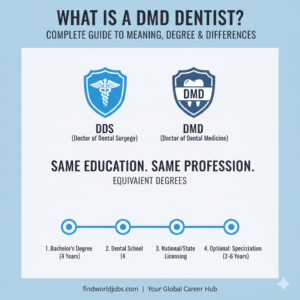

If you’ve ever visited a dentist, you may have noticed different titles after their names — some use DDS, while others use DMD. This often creates confusion, and many patients wonder what these degrees mean and whether there is any difference in training or expertise.
So, what is a DMD dentist and how does this degree compare to others in dentistry? In this complete guide, you’ll learn the meaning of a DMD dentist, education requirements, DMD vs DDS differences, career opportunities, salary expectations, and why the degree matters.
This guide follows expert-backed information and authoritative sources to help you fully understand the dental profession.
What Is a DMD Dentist? (Simple Meaning)
A DMD dentist is a licensed dental professional who holds the degree Doctor of Dental Medicine (DMD). This degree qualifies dentists to diagnose and treat oral health problems, perform dental procedures, and provide preventive dental care.
A DMD dentist performs the same work as any general dentist, including:
-
Examining teeth and gums
-
Diagnosing oral diseases
-
Filling cavities
-
Performing dental procedures
-
Providing preventive dental care
-
Educating patients about oral hygiene
In simple terms, a DMD dentist is a fully qualified dentist with professional training in dental medicine.
What Does DMD Stand For?
DMD stands for Doctor of Dental Medicine (Latin: Dentariae Medicinae Doctoris).
The degree focuses on:
-
Oral health science
-
Dental medicine
-
Clinical dentistry
-
Patient care
-
Preventive treatment
The DMD degree is awarded by accredited dental schools in the United States and other countries.
Why Are There Two Degrees: DMD vs DDS?
One of the biggest questions people ask when learning what is a DMD dentist is how it differs from DDS.
What Is DDS?
DDS stands for Doctor of Dental Surgery.
Both degrees:
-
Require the same education
-
Follow the same training standards
-
Provide the same clinical experience
-
Allow the same professional practice
The only difference is the degree name, not the skill level.
Why Two Different Names Exist
The reason goes back to history.
The first dental degree in the U.S. was DDS. Later, some universities preferred the Latin name for dental medicine and created the DMD title. For example, Harvard School of Dental Medicine awards the DMD degree instead of DDS.
Today, both degrees are equivalent and recognized equally.
DMD vs DDS — Key Differences Table
| Feature | DMD | DDS |
|---|---|---|
| Full Form | Doctor of Dental Medicine | Doctor of Dental Surgery |
| Education | Same | Same |
| Training | Same | Same |
| Licensing | Same | Same |
| Job Opportunities | Same | Same |
| Salary | Same | Same |
👉 There is no difference in quality or expertise.
How Long Does It Take to Become a Dentist? Complete Career Guide
Education Required to Become a DMD Dentist
Understanding what is a DMD dentist also requires understanding the education and training process.
Becoming a DMD dentist requires extensive education and clinical training.
American Dental Education Association — Dental School Requirements
👉 Link: https://www.adea.org
1. Bachelor’s Degree (4 Years)
Before entering dental school, students must complete a bachelor’s degree.
Common majors include:
-
Biology
-
Chemistry
-
Health sciences
-
Biochemistry
Students also complete prerequisite courses such as:
-
Human anatomy
-
Physics
-
Organic chemistry
-
Microbiology
2. Dental Admission Test (DAT)
Students must pass the Dental Admission Test (DAT), which evaluates:
-
Scientific knowledge
-
Academic ability
-
Perceptual skills
-
Reading comprehension
Organizations like the American Dental Education Association provide guidance on dental school admissions and requirements.
3. Dental School (4 Years)
Dental school provides advanced clinical and theoretical training.
First Two Years
-
Classroom learning
-
Medical sciences
-
Oral anatomy
-
Dental techniques
Last Two Years
-
Clinical practice
-
Patient treatment
-
Dental procedures
-
Diagnosis training
Students graduate with a DMD degree after completing the program.
4. Licensing Requirements
After graduation, dentists must obtain a license.
This involves:
-
Passing national board exams
-
Completing clinical examinations
-
Meeting state requirements
Licensing standards are regulated through organizations such as the American Dental Association.
5. Optional Specialization (2–6 Years)
Some DMD dentists pursue specialization in:
-
Orthodontics
-
Oral surgery
-
Pediatric dentistry
-
Periodontics
-
Endodontics
Specialists typically earn higher income and expertise.
What Does a DMD Dentist Do?
A DMD dentist provides complete oral healthcare services.
Common Responsibilities
-
Diagnosing dental conditions
-
Treating cavities
-
Performing root canals
-
Extracting teeth
-
Installing crowns and bridges
-
Cosmetic dentistry procedures
-
Preventive care
-
Patient education
They help maintain both oral and overall health.
Where Do DMD Dentists Work?
After understanding what is a DMD dentist, many people want to know their work environments.
DMD dentists work in various settings:
-
Private dental clinics
-
Hospitals
-
Community health centers
-
Academic institutions
-
Research facilities
-
Government healthcare systems
Many dentists eventually open their own practices.
Is a DMD Dentist a Real Doctor?
Yes, a DMD dentist is a doctor specializing in dental medicine.
However:
-
They are not medical physicians (MD)
-
They specialize in oral health
-
They receive doctoral-level education
Their training qualifies them as healthcare professionals.
How Long Does It Take to Become a DMD Dentist?
The timeline usually includes:
-
Bachelor’s degree — 4 years
-
Dental school — 4 years
-
Optional specialization — 2–6 years
Total Time:
8–12 years depending on specialization.
Skills Required to Become a DMD Dentist
To succeed as a DMD dentist, professionals need:
-
Strong hand-eye coordination
-
Attention to detail
-
Communication skills
-
Problem-solving ability
-
Scientific knowledge
-
Patient care skills
These skills improve treatment quality and patient trust.
How Much Do Dentist Make Per Month & Year? Salary Revealed
Salary of a DMD Dentist
Income varies based on experience, specialization, and location.
Average Salary in the United States
According to the U.S. Bureau of Labor Statistics:
-
Average annual salary: $160,000+
-
Experienced dentists earn significantly more
-
Specialists earn the highest income
Dentistry remains one of the highest-paying healthcare careers.
Career Growth and Opportunities
A DMD dentist has many career paths.
Career Options
-
General dentist
-
Specialist dentist
-
Dental researcher
-
Dental educator
-
Clinic owner
-
Healthcare consultant
Career growth is strong due to increasing healthcare demand.
Benefits of Becoming a DMD Dentist
High Earning Potential
Dentistry offers excellent financial rewards.
Job Stability
Demand for dental care continues to grow.
Professional Respect
Dentists are highly respected healthcare professionals.
Flexible Work Environment
Many dentists manage their own schedules.
Opportunity for Private Practice
Ownership increases independence and income.
Challenges of Becoming a DMD Dentist
Despite advantages, there are challenges:
-
Long education period
-
High tuition costs
-
Competitive admissions
-
Physical demands of work
-
Responsibility for patient care
However, most professionals find the career rewarding.
Future Demand for DMD Dentists
Demand for dental professionals continues to increase due to:
-
Aging population
-
Increased awareness of oral health
-
Growth in cosmetic dentistry
-
Expanding healthcare services
This ensures long-term career stability.
Is DMD Better Than DDS?
No — neither degree is better.
Both provide:
-
Equal education
-
Equal training
-
Equal authority to practice dentistry
-
Equal salary opportunities
The difference is only in the degree name.
How to Choose Between a DMD and DDS Program
Students typically choose based on:
-
University preference
-
Location
-
Program reputation
-
Admission requirements
The degree title does not affect career outcomes.
Is Becoming a DMD Dentist Worth It?
Yes, becoming a DMD dentist is considered a highly rewarding career because it offers:
-
Strong income potential
-
Job security
-
Professional respect
-
Career growth
-
Opportunity to help patients
The long education period is balanced by long-term benefits.
Conclusion
Understanding what is a DMD dentist helps clarify one of the most common confusions in dentistry. A DMD dentist is a licensed dental professional with a Doctor of Dental Medicine degree, qualified to diagnose, treat, and prevent oral health conditions.
The DMD and DDS degrees are identical in education, training, and career opportunities. Becoming a DMD dentist requires significant dedication, typically 8–12 years of education and training, but the profession offers excellent financial rewards, career stability, and professional respect.
For students interested in healthcare, science, and patient care, becoming a DMD dentist is a stable and highly respected career path with strong long-term opportunities.
❓ FAQ — What Is a DMD Dentist?
1. What is a DMD dentist?
A DMD dentist is a dental professional who holds a Doctor of Dental Medicine (DMD) degree. They diagnose and treat oral health problems, perform dental procedures, and provide preventive dental care just like any other licensed dentist.
2. Is a DMD dentist different from a DDS dentist?
No, there is no difference in education, training, or skills. Both DMD (Doctor of Dental Medicine) and DDS (Doctor of Dental Surgery) degrees follow the same curriculum and licensing requirements. The difference is only in the degree name.
3. What does DMD stand for in dentistry?
DMD stands for Doctor of Dental Medicine (Dentariae Medicinae Doctoris in Latin). It is a professional doctoral degree awarded by accredited dental schools.
4. How long does it take to become a DMD dentist?
It typically takes 8–12 years, including:
-
Bachelor’s degree — 4 years
-
Dental school — 4 years
-
Optional specialization — 2–6 years
The timeline depends on career goals and specialization.
5. Can a DMD dentist perform surgery?
Yes. A DMD dentist can perform many dental procedures, including extractions, root canals, and restorative treatments. However, complex surgeries may require additional specialization such as oral surgery.
6. Is a DMD dentist a real doctor?
Yes, a DMD dentist holds a doctoral-level degree in dental medicine and is a licensed healthcare professional. However, they specialize in oral health rather than general medicine.
7. What is the salary of a DMD dentist in the United States?
According to the U.S. Bureau of Labor Statistics, dentists in the United States earn an average salary of over $160,000 per year, with specialists earning significantly higher income.
8. Which degree is better — DMD or DDS?
Neither degree is better. Both provide equal education, career opportunities, and earning potential. Employers and patients treat them the same.
9. Where do DMD dentists work?
DMD dentists work in:
-
Private dental clinics
-
Hospitals
-
Community health centers
-
Research institutions
-
Dental schools
Many also open their own dental practices.
10. Is becoming a DMD dentist worth it?
Yes, dentistry offers strong earning potential, job security, career growth, and professional respect. Although education takes time, the long-term benefits make it a rewarding career.