
Job Overview (Role & Responsibilities)
Before learning how to become a psychologist, it’s essential to understand what psychologists actually do.
Core Responsibilities
-
Conduct therapy sessions (individual, group, or family)
-
Assess mental health conditions
-
Develop treatment plans
-
Perform psychological testing and evaluations
-
Provide crisis intervention
-
Conduct research (for academic psychologists)
-
Write detailed case reports
-
Collaborate with psychiatrists and healthcare professionals
Psychologists do not usually prescribe medication (except in a few states with special certification). Instead, they focus on therapy, counseling, and behavioral interventions.
Why Choose This Job?
Many people researching how to become a psychologist are motivated by both passion and practicality.
1. Meaningful Impact
You directly help people improve their mental health and quality of life.
2. Strong Job Demand
Mental health awareness is growing rapidly.
3. Flexible Work Settings
You can work in hospitals, schools, corporate environments, or private practice.
4. Good Salary Potential
Experienced psychologists can earn six figures.
5. Intellectual Stimulation
The profession requires continuous learning and deep understanding of human behavior.
Job Types / Categories
When exploring how to become a psychologist, it’s important to know the different specializations available.
Clinical Psychologist
Treats mental illnesses in hospitals or private practice.
Counseling Psychologist
Focuses on emotional and relationship challenges.
School Psychologist
Works with students to support academic and emotional development.
Forensic Psychologist
Works within legal and criminal justice systems.
Industrial-Organizational Psychologist
Applies psychology principles in workplace settings.
Neuropsychologist
Studies brain-behavior relationships.
Each specialization has slightly different educational and licensing requirements.
Eligibility Criteria (Qualification & Age Limit)
To understand how to become a psychologist, you must first meet these requirements:
Educational Qualification
-
Bachelor’s degree in psychology or related field
-
Master’s degree (optional but helpful)
-
Doctoral degree (PhD or PsyD)
Age Limit
There is no official age limit. However, due to long educational pathways, most psychologists complete training in their late 20s or early 30s.
Academic Requirements
Strong background in:
-
Psychology
-
Statistics
-
Research methodology
-
Human development
READ MORE- Psychiatrist vs Psychologist (2026): Key Differences, Salary Comparison, Education & Career Outlook
Required Skills (Technical + Soft Skills)
Understanding how to become a psychologist also means developing essential skills.
Technical Skills
-
Psychological assessment tools
-
Research analysis
-
Data interpretation
-
Therapy techniques (CBT, DBT, etc.)
-
Case documentation
Soft Skills
-
Empathy
-
Active listening
-
Communication skills
-
Critical thinking
-
Emotional intelligence
-
Patience
Soft skills are just as important as academic qualifications.
Required Certifications (If Any)
While learning how to become a psychologist, you will encounter certification requirements.
Mandatory:
-
State Licensure
-
Passing the EPPP (Examination for Professional Practice in Psychology)
Optional:
-
Board Certification (ABPP)
-
Specialized therapy certifications (CBT, trauma therapy)
Salary Structure (Fresher to Experienced)
One of the most common questions about how to become a psychologist relates to salary.
Entry-Level (0–2 Years)
$70,000 – $90,000 annually
Mid-Level (3–7 Years)
$90,000 – $115,000 annually
Senior-Level (8+ Years)
$115,000 – $150,000+ annually
Private practice psychologists may earn more depending on client base.
Location-wise Salary Details
Location plays a major role in earnings.
California
$110,000 – $150,000
New York
$100,000 – $140,000
Texas
$90,000 – $120,000
Florida
$85,000 – $115,000
Midwest States
$75,000 – $100,000
Urban areas generally offer higher salaries.
Salary Comparison (Government vs Private / Company-wise)
When considering how to become a psychologist, compare work settings:
Government Jobs
-
Stable income
-
Strong benefits
-
Moderate salary growth
Private Practice
-
Higher earning potential
-
Flexible schedule
-
Income depends on client load
Corporate/Consulting
-
Competitive salaries
-
Performance bonuses
Work Environment & Working Hours
Psychologists typically work:
-
40 hours per week
-
45–60 minute sessions
-
Flexible scheduling (in private practice)
Some roles may require evening sessions to accommodate clients.
Career Growth & Promotion Opportunities
After mastering how to become a psychologist, career advancement includes:
-
Clinical Director
-
Practice Owner
-
Research Lead
-
University Professor
-
Consultant
Experience significantly increases earning potential.
Future Scope & Market Demand (2025–2030)
Mental health services are expanding globally.
Growth drivers include:
-
Teletherapy platforms
-
Workplace wellness programs
-
School counseling demand
-
Increased mental health awareness
The profession is projected to grow steadily through 2030.
Advantages & Disadvantages
Advantages
-
Meaningful career
-
Good salary
-
Flexible work options
-
High job stability
Disadvantages
-
Long education path
-
Student debt
-
Emotionally demanding work
Understanding pros and cons helps when deciding how to become a psychologist.
Top Recruiting Companies / Departments
-
Hospitals and healthcare systems
-
Veterans Affairs (VA)
-
Universities
-
School districts
-
Private clinics
-
Corporate HR departments
Selection Process (Exam / Interview / Skill Test)
Steps include:
-
Admission to doctoral program
-
Internship evaluation
-
EPPP licensing exam
-
State license approval
-
Job interviews
Some employers may conduct case scenario assessments.
Syllabus & Exam Pattern (If Applicable)
EPPP Exam Covers:
-
Biological bases of behavior
-
Cognitive-affective bases
-
Social & cultural psychology
-
Assessment & diagnosis
-
Intervention strategies
-
Ethics
The exam is multiple-choice format.
Important Documents Required
-
Academic transcripts
-
Internship verification
-
Supervised hours documentation
-
EPPP score report
-
State licensure application
-
Resume/CV
FAQs (Frequently Asked Questions)
How long does it take to become a psychologist?
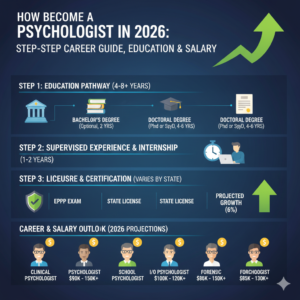
Typically 8–12 years including doctoral training.
Is a master’s degree required?
Not always, but helpful before doctoral admission.
Can psychologists prescribe medication?
Generally no, except in limited states with extra certification.
Is psychology a good career in 2026?
Yes, due to increasing mental health demand.
What is the hardest part of becoming a psychologist?
Completing doctoral training and licensing exams.
How to Apply (Step-by-Step Guide with Official Link Info)
Here is the practical roadmap for how to become a psychologist:
Step 1: Earn a Bachelor’s Degree
Major in psychology or related field.
Step 2: Apply to Accredited Doctoral Programs
Search accredited programs:
https://accreditation.apa.org/accredited-programs
Step 3: Complete Doctoral Degree (PhD or PsyD)
Step 4: Complete Supervised Internship
Step 5: Pass the EPPP Exam
Exam details:
https://asppb.net/page/EPPP
Step 6: Apply for State Licensure
Visit your state psychology board website.
Step 7: Apply for Jobs
Search through:
-
Indeed.com
-
Hospital career portals
1 thought on “How to Become a Psychologist in 2026: Step-by-Step Career Guide, Education & Salary”
Comments are closed.