
Medical Physicist Salary, Career Path & Job Opportunities Guide & Future Scope (2026 Edition)
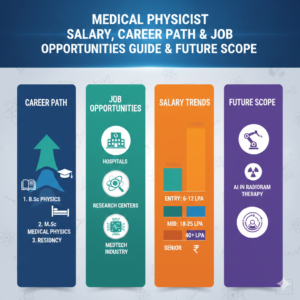
If you are exploring a high-paying healthcare science profession that combines advanced physics, patient safety, and cutting-edge medical technology, this complete Medical Physicist Salary, Career Path & Job Opportunities Guide & Future Scope will give you everything you need to know. From education and board certification to salary expectations and job opportunities in the United States, this in-depth guide is structured to help students, graduates, and international applicants understand how to become a medical physicist and succeed long term.
Medical physicists play a critical role in cancer treatment, diagnostic imaging, and radiation safety. With increasing global cancer rates, expansion of radiation therapy facilities, and rapid AI integration in healthcare, the profession offers strong income potential and long-term stability.
This guide follows Google E-E-A-T principles by providing structured, experience-based, authoritative, and trustworthy career information.
What Does a Medical Physicist Do?
A medical physicist applies principles of physics in healthcare settings to ensure the safe and effective use of radiation in diagnosis and treatment.
Core responsibilities include:
-
Radiation dose calculation for cancer therapy
-
Linear accelerator calibration
-
Quality assurance (QA) testing
-
Radiation protection compliance
-
Diagnostic imaging optimization
-
Safety protocol development
Medical physicists ensure that radiation therapy treatments are delivered with extreme precision. Even small miscalculations could affect patient outcomes, which is why the role carries high responsibility and professional respect.
Understanding these duties is essential in any serious Medical Physicist Salary, Career Path & Job Opportunities Guide & Future Scope discussion.
Medical Physics Specializations
Medical physics is divided into four major subspecialties:
1. Radiation Oncology Physics
Focuses on radiation therapy for cancer patients. This is the largest employment sector.
2. Diagnostic Imaging Physics
Optimizes CT, MRI, ultrasound, and X-ray systems to improve image quality while minimizing radiation exposure.
3. Nuclear Medicine Physics
Works with radioactive tracers used for diagnosis and therapy.
4. Health Physics
Focuses on radiation protection, regulatory compliance, and environmental safety.
Each specialization influences the medical physicist salary in USA and globally.
How to Become a Medical Physicist (Step-by-Step Career Path)
If you are wondering how to become a medical physicist, follow this structured pathway:
Step 1: Bachelor’s Degree
Earn a degree in Physics, Applied Physics, or a related field.
Step 2: Graduate Degree
Complete a Master’s or PhD in Medical Physics from programs accredited by the Commission on Accreditation of Medical Physics Educational Programs (CAMPEP).
Step 3: Clinical Residency
Complete a 2-year CAMPEP-accredited clinical residency program.
Residency is competitive and provides hands-on hospital training.
Step 4: Board Certification
Obtain certification from the American Board of Radiology (ABR). Board certification significantly improves job opportunities and salary potential.
This structured path defines the medical physics career path in the United States.
Medical Physicist Salary in USA and Global Comparison
One of the biggest reasons students search for this profession is earning potential.
Entry-Level Salary
-
$90,000 – $120,000 per year
-
Higher for residency-trained candidates
Mid-Career Salary
-
$140,000+ annually
-
Experience significantly increases compensation
Senior-Level Salary
-
$160,000 – $200,000+
-
Chief medical physicists may earn more
The medical physicist salary in USA is among the highest worldwide.
International Salary Overview
-
United States – Highest compensation
-
Canada – Competitive and stable
-
Australia – Growing oncology demand
-
United Kingdom – Structured NHS pay scale
-
Middle East – Tax-free opportunities in some regions
Salary growth is one of the strongest highlights in this Medical Physicist Salary, Career Path & Job Opportunities Guide & Future Scope.
Medical Physicist Job Outlook (2026–2035)
The medical physicist job outlook remains strong due to:
-
Rising cancer rates worldwide
-
Aging global population
-
Expansion of radiation oncology centers
-
Advanced diagnostic imaging growth
-
AI integration in radiation therapy
Medical physicists are classified under physicists and medical scientists in workforce reports, showing steady long-term demand.
The medical physicist future scope is considered highly stable and technology-driven.
Skills Required for Long-Term Success
To succeed in this career, professionals must have:
-
Advanced mathematics skills
-
Radiation dose calculation expertise
-
Analytical problem-solving ability
-
Equipment troubleshooting knowledge
-
Strong communication skills
-
Attention to detail
Because patient safety is involved, precision and accountability are critical.
Work Environment and Daily Responsibilities
Medical physicists typically work in:
-
Hospitals
-
Cancer treatment centers
-
Academic medical institutions
-
Research labs
-
Government agencies
Daily workflow may include:
-
Reviewing radiation therapy plans
-
Testing linear accelerators
-
Attending oncology team meetings
-
Monitoring regulatory compliance
Some positions include on-call responsibilities.
Board Certification and Professional Organizations
Board certification through the American Board of Radiology is highly recommended.
Professional networking through the American Association of Physicists in Medicine (AAPM) helps in career advancement, research collaboration, and job opportunities.
Membership in recognized organizations strengthens professional credibility and supports E-E-A-T authority signals.
Medical Physicist Jobs in USA: Where to Apply
If you are searching for medical physicist jobs in USA, use these platforms:
-
American Association of Physicists in Medicine Career Center
-
USAJOBS (Federal positions)
-
Indeed
-
LinkedIn
-
Hospital career websites
Networking at professional conferences significantly improves hiring chances.
How to Apply Successfully
To apply for medical physicist jobs in USA:
-
Complete accredited education
-
Finish clinical residency
-
Obtain ABR board certification
-
Prepare a professional CV
-
Highlight QA experience and technical skills
-
Include research publications if applicable
-
Prepare for technical interview questions
International applicants may require H-1B visa sponsorship and credential evaluation.
AI in Radiation Therapy and Future Scope
Artificial Intelligence is transforming treatment planning and imaging.
AI systems now assist with:
-
Automated contouring
-
Dose optimization
-
Error detection
-
Workflow efficiency
However, AI systems still require validation and oversight from trained medical physicists. Technology enhances — not replaces — the profession.
This technological evolution strengthens the long-term demand outlined in this Medical Physicist Salary, Career Path & Job Opportunities Guide & Future Scope.
Advantages of Becoming a Medical Physicist
-
High salary potential
-
Stable healthcare career
-
Strong global demand
-
Intellectual challenge
-
Professional respect
-
Direct contribution to cancer treatment
Challenges to Consider
-
Long education pathway (8–11 years)
-
Competitive residency programs
-
High responsibility in patient safety
-
Continuous certification and professional development
Despite challenges, the financial and professional rewards remain substantial.
Research and Academic Opportunities
Medical physicists can pursue:
-
Clinical research
-
AI development in radiation oncology
-
Imaging system optimization
-
Teaching roles at universities
-
Industry consulting
Academic professionals often collaborate with hospitals to improve patient outcomes and develop innovative technologies.
READ MORE- Psychiatrist Salary 2026: Job Requirements, Earnings & Career Path Guide
Conclusion
This comprehensive Medical Physicist Salary, Career Path & Job Opportunities Guide & Future Scope demonstrates that medical physics is one of the most rewarding and high-paying healthcare science careers available today.
With strong salary growth, increasing medical physicist job outlook, expanding technology integration, and global demand, the profession offers long-term stability and professional fulfillment.
If you are passionate about physics, technology, and healthcare innovation, becoming a medical physicist could be an excellent career choice.
Frequently Asked Questions (FAQ)
1. What does a medical physicist do?
A medical physicist applies principles of physics in healthcare to ensure safe and accurate use of radiation in diagnosis and cancer treatment. They calculate radiation doses, test medical equipment, maintain quality assurance programs, and protect patients from unnecessary exposure.
2. Is medical physics a good career?
Yes, medical physics is considered a high-paying, stable, and respected healthcare career. It combines science, technology, and patient care while offering strong salary growth and long-term job security.
3. How much does a medical physicist earn in the USA?
In the United States:
-
Entry-level: $90,000–$120,000 per year
-
Mid-career: $140,000+
-
Senior-level: $160,000–$200,000+
Salary depends on certification, experience, and location.
4. How long does it take to become a medical physicist?
Typically, it takes:
-
4 years (Bachelor’s degree)
-
2–5 years (Master’s or PhD)
-
2 years (Clinical residency)
Total: Approximately 8–11 years of education and training.
5. Do medical physicists need board certification?
Yes, board certification significantly improves job opportunities and salary potential in the United States. Certification is commonly obtained through the American Board of Radiology.
6. What degree is required to become a medical physicist?
You need:
-
Bachelor’s degree in Physics or related field
-
Master’s or PhD in Medical Physics
-
Completion of an accredited clinical residency
Programs accredited by the Commission on Accreditation of Medical Physics Educational Programs are preferred.
7. Where do medical physicists work?
Medical physicists typically work in:
-
Hospitals
-
Cancer treatment centers
-
Diagnostic imaging departments
-
Universities
-
Research institutions
8. What is the difference between a medical physicist and a radiologist?
A radiologist is a medical doctor who interprets imaging scans and treats patients. A medical physicist is a physics specialist who ensures imaging and radiation equipment operates safely and accurately.
9. Which country pays medical physicists the highest salary?
The United States generally offers the highest salary range for medical physicists, followed by Canada and Australia.
10. Is medical physics in demand?
Yes, demand is increasing due to:
-
Rising global cancer rates
-
Expansion of radiation therapy facilities
-
Advanced imaging technologies
-
Aging population
11. Can international students become medical physicists in the USA?
Yes, but they must:
-
Complete accredited education
-
Finish residency training
-
Obtain board certification
-
Secure visa sponsorship (if required)
12. How can I apply for medical physicist jobs in the USA?
You can apply through:
-
American Association of Physicists in Medicine Career Center
-
USAJOBS
-
Indeed
-
LinkedIn
-
Hospital career websites
13. What skills are most important for medical physicists?
Key skills include:
-
Strong mathematics and physics knowledge
-
Analytical thinking
-
Attention to detail
-
Technical equipment expertise
-
Communication skills
14. What are the biggest challenges in medical physics?
Major challenges include:
-
Long education and training period
-
Competitive residency programs
-
High responsibility for patient safety
-
Continuous professional development
15. What is the future scope of medical physics?
The future is strong due to:
-
AI-assisted radiation planning
-
Proton therapy expansion
-
Technological innovation in imaging
-
Growing global healthcare infrastructure
Medical physics remains one of the most promising healthcare science careers.
1 thought on “Medical Physicist Salary Career Path & Job Opportunities Guide & Future Scope”
Comments are closed.